Commercial Hydroponic & Fertigation Nutrient Formulator
Precision stoichiometric formulation for high-wire greenhouse crops, indoor CEA, and recirculating NFT/DWC systems.
Global Agronomic Guidelines & Hydroponic Stoichiometry
In high-density commercial production across Europe, North America, and high-tech vertical farms, nutrient formulations are calibrated around ionic equilibrium and target **Electrical Conductivity (EC)**. Managing individual ion thresholds (mg/L or PPM) prevents toxic accumulation and antagonistic nutrient lockout.
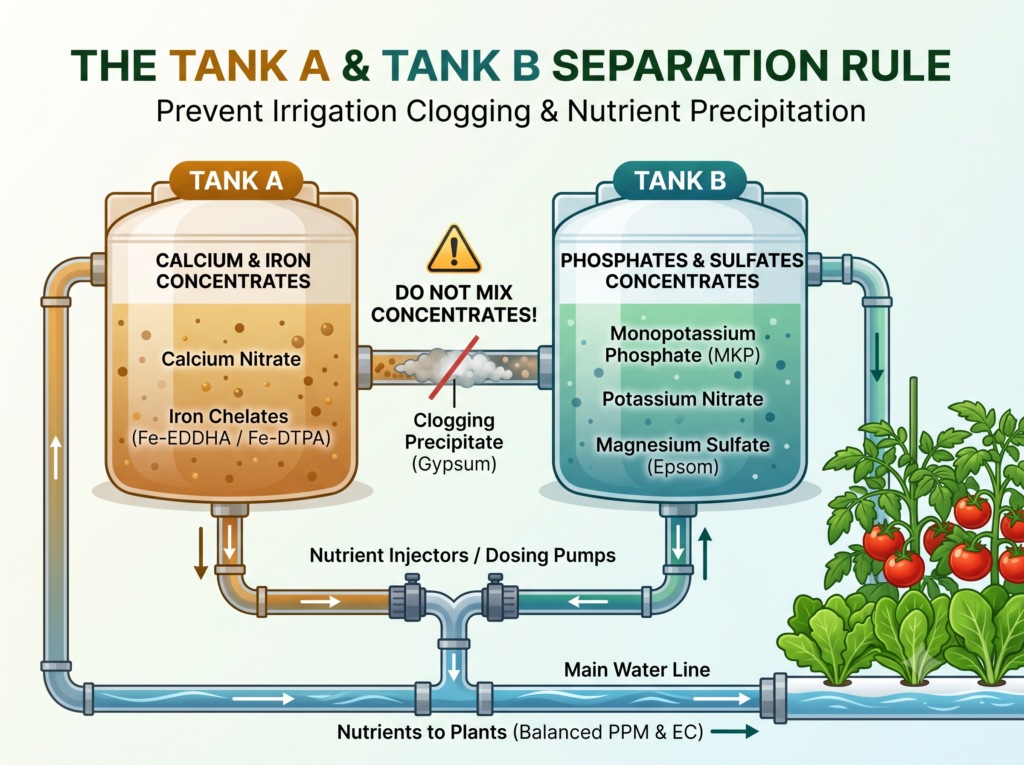
1. The Tank A vs. Tank B Separation Protocol
A critical engineering failure in automated fertigation is crystallization in stock concentrate tanks[cite: 1]. At commercial stock concentrations (100x to 200x), incompatible salts must remain isolated[cite: 1]:
- Tank A (Calcium & Chelated Iron): Contains Calcium Nitrate and Iron Chelates (Fe-DTPA / Fe-EDDHA)[cite: 1]. Calcium ions ($Ca^{2+}$) remain chemically stable in the absence of sulfates and phosphates[cite: 1].
- Tank B (Phosphates, Potassium & Sulfates): Contains Monopotassium Phosphate (MKP), Potassium Nitrate, Magnesium Sulfate (Epsom salt), and essential micronutrients (Boron, Zinc, Manganese, Copper, Molybdenum)[cite: 1].
- Precipitation Hazard: Blending concentrated Calcium with Sulfates generates insoluble Gypsum ($CaSO_4$), while blending with Phosphates precipitates insoluble Tricalcium Phosphate ($Ca_3(PO_4)_2$)[cite: 1]. Both reactions cause permanent nozzle blockages in drip emitters and nutrient starvation[cite: 1].
2. Stoichiometric Mass Calculation Formula
Elemental concentration in parts per million (PPM) relates to the mass of commercial grade salt via the compound’s purity percentage:
Mass of Fertilizer (g) = [ Target PPM (mg/L) × Total Solution Volume (L) ] / [ Purity Fraction × 1,000 ]
Where purity fractions reflect commercial standards: Calcium Nitrate (~19% Ca, 15.5% N), Potassium Nitrate (~38.6% K, 13.8% N), and Monopotassium Phosphate (~22.7% P, 28.2% K).
3. EC Deduction and Osmotic Control
Source water quality dictates ultimate plant health. If baseline municipal or well water exhibits an initial EC exceeding 0.4 mS/cm, residual salts (predominantly $Na^+$ and $Cl^-$) add unbeneficial osmotic pressure. Operators must subtract native mineral contributions or install industrial Reverse Osmosis (RO) filtration systems to preserve nutrient absorption capacity.