FAO-56 Penman-Monteith Evapotranspiration & Water Sizer
Standardized reference evapotranspiration (ETₒ) and crop coefficient (K꜀) irrigation scheduling engine.
Principles of FAO-56 Penman-Monteith Evapotranspiration
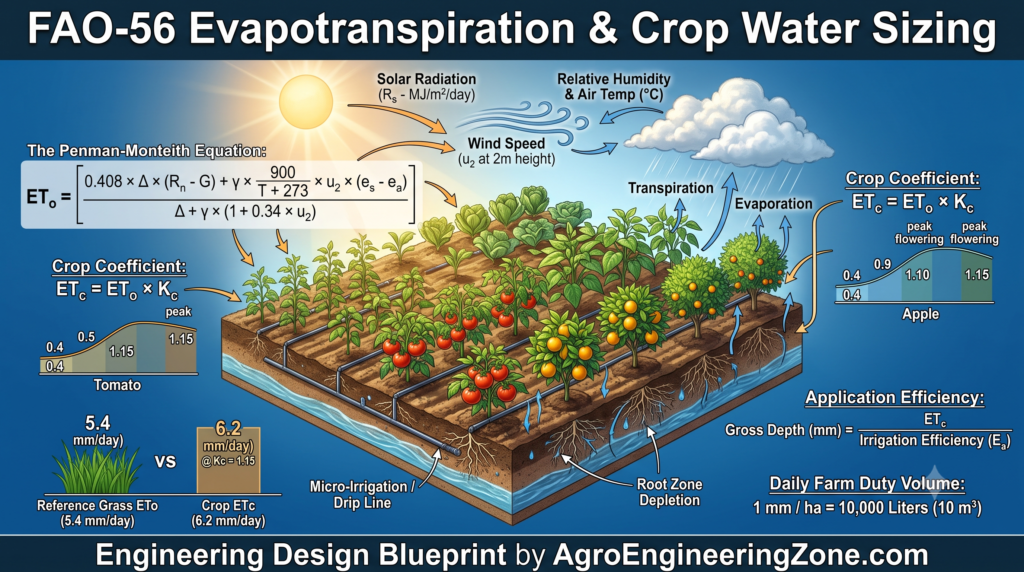
Accurate agricultural water allocation hinges on separating the atmosphere’s evaporative power from the specific biological canopy resistance of a crop. The United Nations Food and Agriculture Organization (FAO) Paper No. 56 established the Penman-Monteith method as the sole universal biophysical benchmark for calculating reference evapotranspiration ($ET_o$).
1. The Governing Biophysical Equation
The standard equation integrates both radiative and aerodynamic energy terms over a hypothetical grass reference canopy (height 0.12 m, albedo 0.23, surface resistance 70 s/m):
ET_o = [ 0.408 × Δ × (R_n – G) + γ × (900 / (T + 273)) × u_2 × (e_s – e_a) ] / [ Δ + γ × (1 + 0.34 × u_2) ]
Where:
- R_n: Net radiation flux at the crop surface ($MJ/m^2/day$).
- G: Soil heat flux density ($MJ/m^2/day$, near 0 on a daily step).
- T: Mean daily air temperature at 2 m height (°C).
- u_2: Wind speed measured at 2 m elevation ($m/s$).
- (e_s – e_a): Vapor pressure deficit (VPD) of the atmosphere ($kPa$).
- Δ: Slope of the saturation vapor pressure curve ($kPa/°C$).
- γ: Psychrometric constant (~0.067 kPa/°C at sea level).
2. Single Crop Coefficient Approach (ETc)
Actual crop water loss ($ET_c$) varies throughout the phenological cycle. By scaling $ET_o$ with the crop coefficient ($K_c$):
ET_c = ET_o × K_c
During initial vegetative emergence, $K_c$ remains low (0.4–0.7) as bare soil evaporation dominates. During peak flowering and fruit sizing, dense leaf area index (LAI) drives $K_c$ up to 1.05–1.20, creating the season’s highest water demand.
3. Converting Depletion to Gross Irrigation Volume
No irrigation system delivers 100% uniformity. Gross irrigation depth accounts for application inefficiencies:
Gross Depth (mm) = ET_c / Application Efficiency (E_a)
One millimeter of water applied across one hectare equals exactly **10,000 liters (10 m³)**. Converting depth to volumetric application prevents root-zone deficit stress and excessive drainage runoff.