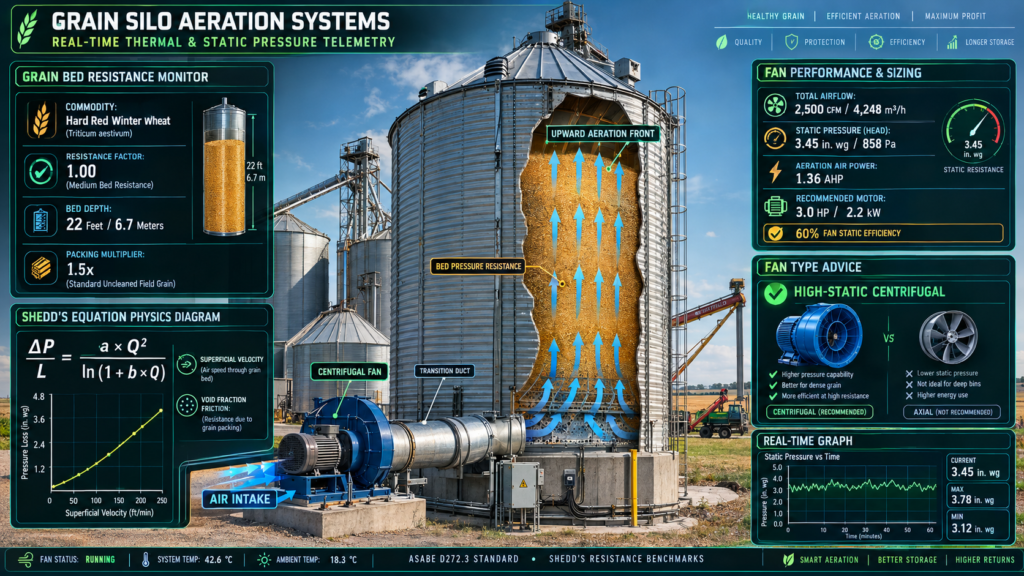
Grain Silo Aeration, Static Pressure & Fan Sizer
Calculate aeration delivery volume, static pressure loss via Shedd’s resistance curves, bed compaction safety margins, and blower motor horsepower.
1. Storage & Grain Parameters
ASABE EP413Engineering Principles of Grain Silo Aeration, Bed Resistance & Blower Aerodynamics
1. Aeration Dynamics vs. High-Temperature Grain Drying
In post-harvest grain storage engineering, aeration is definitively distinct from heated-air artificial grain drying. The mechanical objective of aeration is not rapid mass evaporation of bulk moisture, but the preservation of biological stability. Forced ambient air suppresses internal convective currents driven by seasonal outside temperature differentials. Without aeration, warm air rises through the silo core, absorbs interstitial moisture, and condenses against cold top roof sheets, inducing localized mold crusting, mycotoxin accumulation, and spontaneous germination.
2. Airflow Resistance Physics: Shedd’s Formula & Grain Void Fractions
Granular agricultural commodities packed within storage silos act as porous media. As air traverses vertically from the aeration plenum through interstitial grain voids, momentum is dissipated by viscous friction against kernel skins and kinetic turbulence at pore choke points. Standardized by ASABE D272.3, this resistance is mathematically modeled via Shedd’s empirical formulation:
Total Static Pressure (in. wg) = [ (ΔP / L) × Bed_Depth × Packing_Multiplier ] + Transition_Duct_Friction
Where Q represents the superficial apparent air velocity (defined as total delivery CFM divided by cross-sectional bin floor area in sq. ft), L is grain column height, and a and b are empirical commodity constants. Void geometry dictates hydraulic head loss: spherical kernels like soybeans provide large void fractions and low friction, whereas canola seeds or fibrous rough rice generate micro-capillary paths that trigger drastic backpressure spikes.
3. The Compaction Multiplier (Fines & Mechanical Loading)
Laboratory Shedd data assumes uniform, clean, loose-fill beds. In commercial farm silos, grain dropped from fill augers packs under mechanical impact. Furthermore, broken kernels, grain dust, and weed seeds settle into a dense core along the silo centerline (the spouted funnel zone). Under ASABE EP413.2 recommendations, design engineers apply a mandatory 1.2x to 1.8x packing multiplier to loose-fill resistance calculations, supplemented by 0.50 inches of water gauge to account for transition duct, perforated floor orifice, and roof exhaust vent friction.
4. Aeration Blower Aerodynamics: Axial vs. Centrifugal Mechanics
The mechanical shaft work required to circulate air against bed static resistance is defined by fluid horsepower kinetics:
Blower Motor BHP = Air Horsepower / Fan Static Mechanical Efficiency (η)
- Vane-Axial Aeration Fans (3450 RPM): Best suited for low-static pressure regimes (below 3.5 to 4.0 in. wg). They provide cost-effective CFM per dollar in shallow bins but suffer from aerodynamic stall, blade cavitation, and motor overheating when pushed against deep beds.
- In-Line & Double-Inlet Centrifugal Blowers (1750 RPM): Mandatory when static pressure exceeds 4.5 in. wg (commercial wheat, paddy, canola, and tall elevator silos). Backward-curved centrifugal impellers maintain steady CFM output against steep head resistance and operate quietly with non-overloading power curves.