Drip Irrigation Hydraulics & Pump Sizer
Compute Hazen-Williams friction losses, total dynamic head (TDH), and required brake horsepower (BHP).
Fundamentals of Drip Irrigation Hydraulic Design
Designing a micro-irrigation network requires balancing pressure uniformity across lateral lines with economic pipe sizing. If the pipe diameter is too small, excessive friction head loss leads to non-uniform discharge and emitter clogging; if oversized, capital investment spikes unnecessarily.
1. The Hazen-Williams Friction Loss Equation
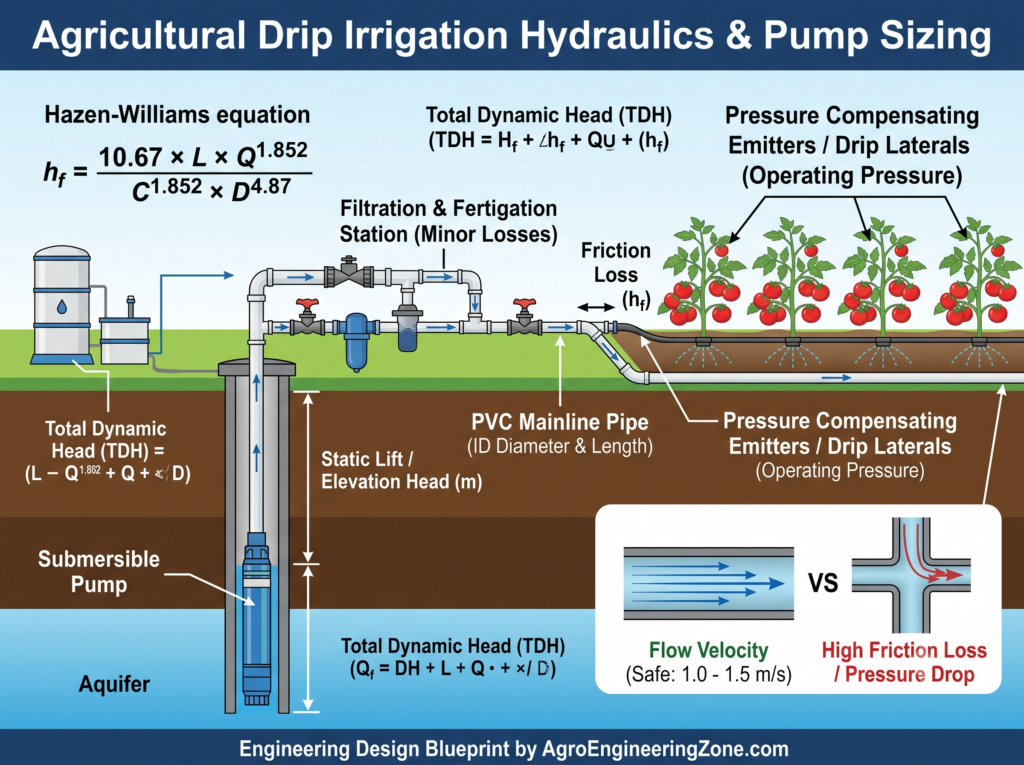
Frictional head loss ($h_f$) in closed circular water conduits is governed by the empirical Hazen-Williams equation:
h_f = 10.67 × L × Q^1.852 / (C^1.852 × D^4.87)
Where:
- h_f: Frictional head loss in meters of water ($m$).
- L: Pipe length ($m$).
- Q: Volumetric flow rate ($m^3/s$).
- D: Pipe inside diameter ($m$).
- C: Pipe roughness coefficient ($C = 150$ for standard PVC/HDPE).
2. Total Dynamic Head (TDH) Formulation
The total operating pressure a pump must deliver at the wellhead or booster station is defined as:
TDH = Static Lift (m) + Operating Emitter Head (m) + Pipe Friction Loss (m) + Minor Losses (Fittings/Filters)
Media filters (sand gravel), disc filters, and fertigation venturi units typically incur an additional head loss of 0.3 to 0.6 bar (3 to 6 meters). The calculator automatically integrates an engineering allowance of 15% minor losses into the final TDH value.
3. Recommended Velocity Thresholds
According to ASABE EP458 standards, water flow velocity in agricultural delivery mains should remain between **1.0 m/s and 1.5 m/s (3.2 to 5.0 ft/s)**. Velocities exceeding 2.0 m/s create catastrophic water hammer pressure surges during valve closure, while velocities under 0.6 m/s cause silt sedimentation.