Soil CEC, Base Saturation & Lime/Gypsum Sizer
Compute total Cation Exchange Capacity (CEC), base saturation ratios, and precision calcium amendment tonnage.
Principles of Cation Exchange Capacity & Albrecht Base Saturation
Cation Exchange Capacity (CEC) measures the total negative charge sites on clay platelets and organic matter capable of holding positively charged nutrient ions against leaching. Managing base saturation percentages delivers far superior structural flocculation and biological mineralization than simple N-P-K volumetric applications.
1. Elemental Milliequivalent (meq) Conversion Factors
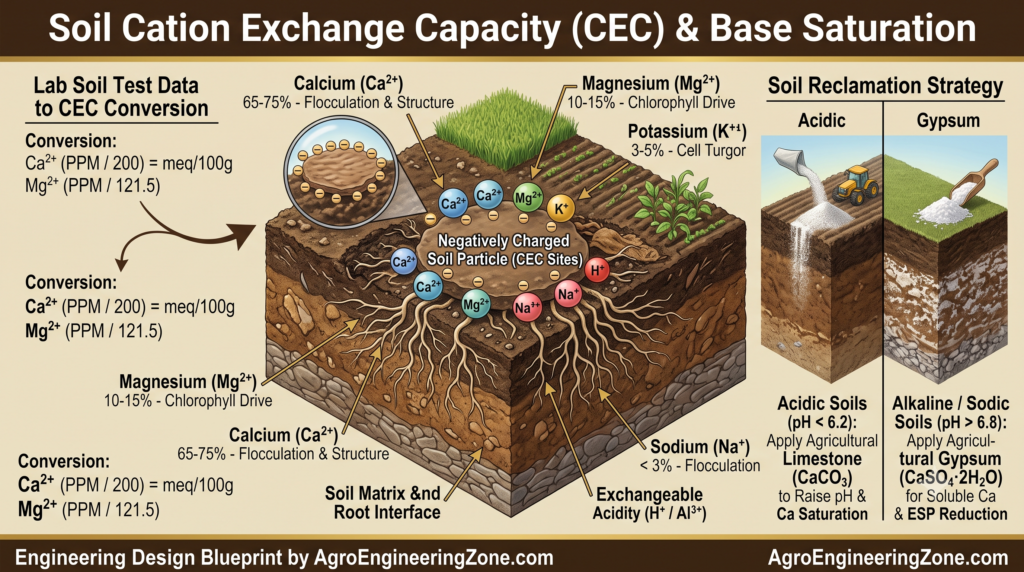
Soil testing laboratories frequently report cations in mg/kg (parts per million). To convert PPM to charge milliequivalents ($meq/100g$), divide by the element’s equivalent weight factor:
- Calcium ($Ca^{2+}$): Divide PPM by 200 (Valence 2, Atomic Mass 40.08)
- Magnesium ($Mg^{2+}$): Divide PPM by 121.5 (Valence 2, Atomic Mass 24.31)
- Potassium ($K^+$): Divide PPM by 391 (Valence 1, Atomic Mass 39.10)
- Sodium ($Na^+$): Divide PPM by 230 (Valence 1, Atomic Mass 23.00)
2. Albrecht / Kinsey Ideal Base Saturation Ratios
Pioneered by Dr. William Albrecht at the University of Missouri, optimal soil biological health and aeration flocculation occur when CEC exchange sites are occupied within balanced equilibrium brackets:
- Calcium ($Ca$): 65% to 75% of total CEC (flocculates clay, drives root respiration)
- Magnesium ($Mg$): 10% to 15% (drives chlorophyll, binds loose sandy soils)
- Potassium ($K$): 3% to 5% (cell turgor, enzyme activation)
- Sodium ($Na$): < 3% (> 5% causes deflocculation, crusting, and poor hydraulic conductivity)
- Exchangeable Acidity ($H + Al$): 10% to 15% in slightly acidic soils, < 5% in neutral conditions.
3. The Lime vs. Gypsum Remediation Rule
Choosing between Agricultural Limestone and Gypsum is determined by baseline soil pH:
- Use Calcitic Lime ($CaCO_3$): When soil pH is below 6.2. The carbonate anion ($CO_3^{2-}$) binds free hydrogen ions, elevating pH while calcium saturates the exchange complex.
- Use Agricultural Gypsum ($CaSO_4\cdot 2H_2O$): When soil pH is neutral or alkaline (pH > 6.8) or when remediating sodic soils ($ESP > 5\%$). Gypsum provides soluble calcium without elevating pH, and the sulfate anion forms sodium sulfate ($Na_2SO_4$), which leaches harmlessly down the drainage profile.