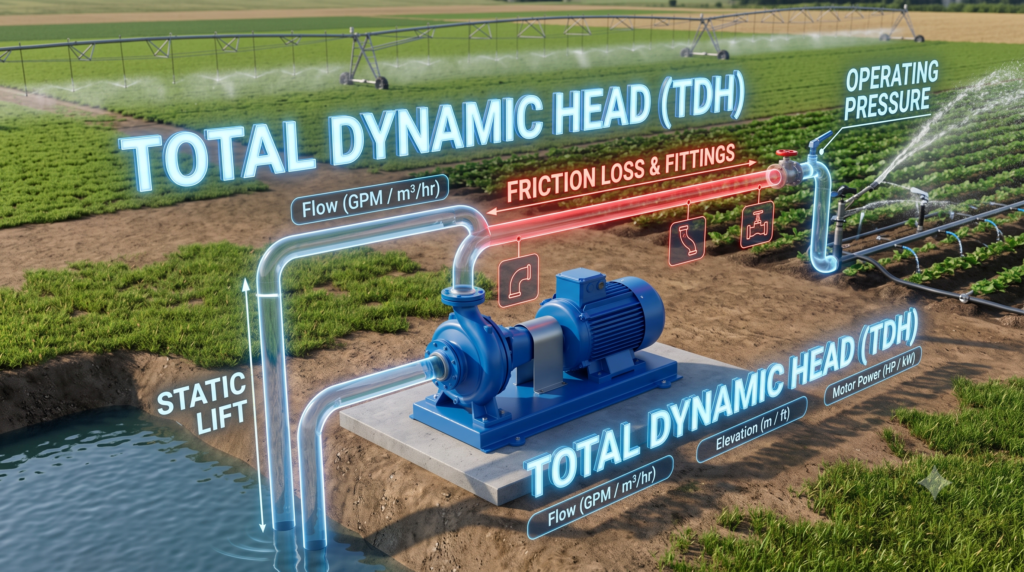
Commercial Farm Pump & Total Dynamic Head (TDH) Calculator
Accurately size irrigation booster pumps, submersible well motors, and brake horsepower (BHP).
Principles of Irrigation Pump Sizing & Total Dynamic Head (TDH)
Selecting an undersized pump leads to dry irrigation zones and uneven fertigation distribution, while an oversized pump causes high energy costs and frequent pipe bursts. Sizing requires calculating the exact hydraulic energy resistance the pump must overcome.
1. The Total Dynamic Head (TDH) Formulation
Total Dynamic Head represents the work per unit weight of fluid required to lift and transport water from the water source to the furthest emitter:
TDH = Static Elevation Lift + Operating Pressure Head + Mainline Pipe Friction + Fitting Losses
- Static Lift ($H_s$): Vertical elevation rise from low water pumping level to the highest emitter.
- Operating Pressure Head ($H_p$): Pressure required at the nozzle or emitter ($1\text{ bar} = 10.197\text{ m of head} = 2.31\text{ ft/psi}$).
- Pipe Friction Loss ($H_f$): Resistance against internal pipe walls calculated via Hazen-Williams equation.
- Minor Losses ($H_m$): Localized turbulence at elbows, tees, check valves, and filter manifolds (typically 10%–20% of pipe friction).
2. Water Horsepower (WHP) vs. Brake Horsepower (BHP)
Water Horsepower is the theoretical energy imparted to water:
WHP = (Flow in GPM × TDH in Feet) / 3960 = (Flow in m³/hr × TDH in Meters) / 270
Pumps lose energy through mechanical friction and impeller slip. Brake Horsepower accounts for pump efficiency ($\eta_p$):
BHP = WHP / Efficiency
3. Mainline Flow Velocity Guidelines
For longevity of PVC and HDPE piping, water velocity must stay between **1.0 m/s and 2.1 m/s (3 to 7 ft/s)**. Velocities above 2.5 m/s cause catastrophic water hammer (hydraulic shock waves), while velocities below 0.6 m/s permit sediment deposition inside delivery pipes.