
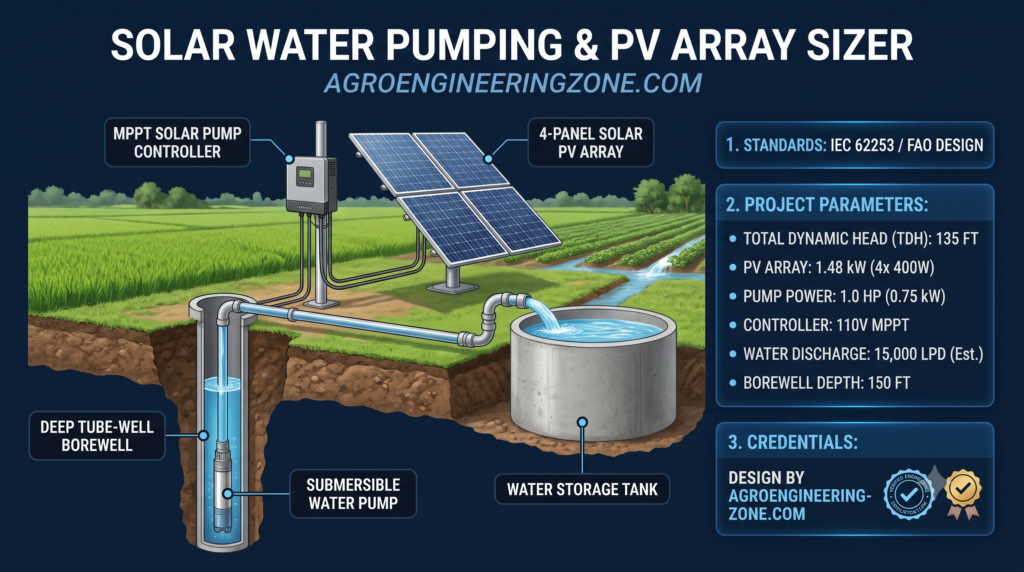
Solar Water Pumping System Sizer, PV Array & HP SPECIFIER
Calculate Total Dynamic Head (TDH), optimal PV Array Kilowatt requirements, daily water yield profiles, and required MPPT pump controller specifications worldwide.
1. Input Hydraulic & Solar Data
IEC 62253Engineering Mechanics of Solar Water Pumping & PV Array Sizing
1. Physics of Total Dynamic Head (TDH) & Hydraulic Lift
In off-grid solar water pumping, accurate calculation of the Total Dynamic Head (TDH) is critical. TDH represents the total equivalent height of water lift that the pump must work against to deliver fluid to its discharge destination. It comprises:
TDH = Vertical Lift + Elevation + Friction Losses + Pressure Drop.
Vertical Lift (or static lift) is the vertical distance between the water table (drawdown level) and the point of discharge. Friction losses occur as fluid travels through pipeline pipelines, elbow fittings, and check valves, governed by the Hazen-Williams or Darcy-Weisbach formulations. Inadequate estimation of friction losses can result under-sizing the mechanical motor HP, while over-estimating results in high capital cost.
2. Photovoltaic Derating Factor & Peak Sun Hours
Direct Sunlight (measured as Peak Sun Hours, PSH) varies based on geographic location and seasonal daylight cycles. However, sizing an off-grid solar array requires factoring in real-world environmental derating conditions (also called safety factors).
Oversizing factors are applied at a range of 15% to 40% (depending on dust, soiling, wire voltage drop, high-temperature efficiency coefficients, and age degradation). For instance, in dusty arid farmlands, panels naturally accumulate dust, which decreases output. In addition, solar panels experience output degradation under high cell temperature operations. High cell temperature decreases PV wattage output at a rate of roughly 0.4% per degree Celsius above 25°C.
3. Pump Mechanics and Controller
For solar water pumps, use of variable speed MPPT controllers is standard practice. Maximum Power Point Tracking (MPPT) matches the motor speed to the real-time electrical output of the solar panel array as Sunlight changes.
Traditional centrifugal pumps have low starting torque, making them suited for direct connection to PV modules under full Sunlight. Progressive cavity pumps provide higher starting torque at lower light levels, making them better suited for deep well applications with fluctuating daily solar radiation.