
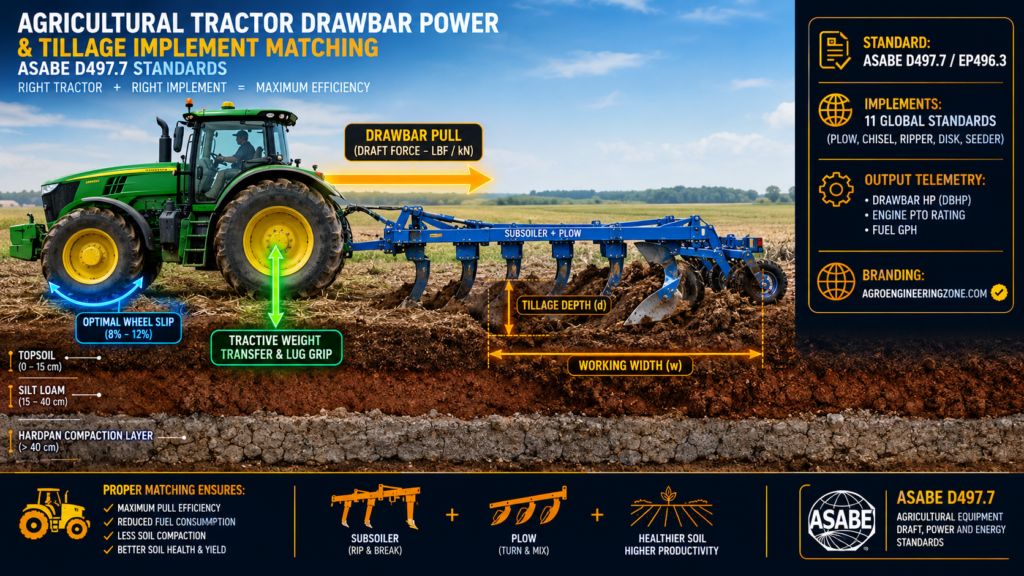
Tractor Drawbar Power, Tillage Draft & All-Implement Matcher
Engineering-grade sizing for 11 worldwide tractor-drawn implements. Compute specific soil draft (lbf/kN), required Drawbar HP (DBHP), tractor engine & PTO rating, tractive efficiency, and hourly diesel fuel burn.
1. Implement & Soil Setup
11 ASABE ImplementsEngineering Principles of Tractor-Implement Matching, Soil Draft Mechanics & Tractive Efficiency
1. Soil-Tool Interaction & Governing ASABE D497 Formulas
Agricultural implement draft is the total horizontal drawbar force required to move a tillage or seeding tool through the soil along its line of travel. Draft resistance arises from complex dynamic soil interactions: overcoming soil tensile and shear strength, frictional sliding of soil over polished steel tools, inter-particle soil friction, and kinetic acceleration of soil aggregates. Under the standardized ASABE D497.7 engineering code, draft is modeled as:
Where $V$ is forward ground speed in MPH, $w$ is implement width, $d$ is operating depth, $F_s$ is the soil texture adjustment factor (ranging from 0.60 for coarse loose sand to 1.55 for heavy expansive clay), and $A, B, C$ are empirical tool geometry coefficients. For tools like vertical tillage or disc harrows, draft increases non-linearly with speed due to quadratic kinetic throw forces.
2. Drawbar Horsepower & Tractive Power Conversion
Drawbar Horsepower (DBHP) is the net fluid tractive power developed at the hitch:
Required PTO Horsepower = Drawbar Horsepower / Tractive Efficiency (η)
Because pneumatic rubber tires slip against loose soil matrices, considerable engine power is dissipated as shear slip and rolling resistance. In tilled to firm agricultural fields, average tractive efficiencies are:
• 2WD Tractors: 65% – 68%
• MFWD (Mechanical Front Wheel Drive): 72% – 74%
• 4WD Articulated Duals: 75% – 77%
• Rubber Tracked Systems: 78% – 81%
To maintain engine longevity and avoid dangerous transmission heat buildup, design engineers size tractors so continuous drawbar work demands only 80% of rated PTO capacity.
3. Diesel Fuel Consumption Estimation
Field fuel consumption under varying draft load conditions is modeled via ASABE EP496.3 volumetric coefficients:
Matching implement sizing to tractor ballast ensures wheels operate within the optimal 8% to 12% slip window. Over-ballasting causes severe subsoil compaction, while under-ballasting causes excessive tire spinning, destroying fuel efficiency.