
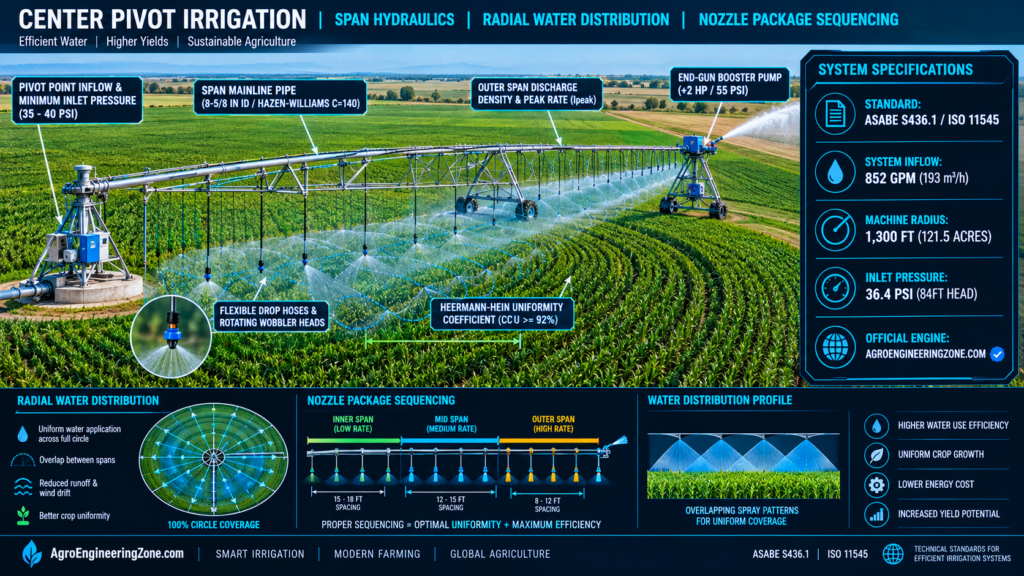
Center Pivot Span Hydraulics, Nozzle Package & End-Gun Booster Sizer
Industrial mechanized irrigation telemetry by AgroEngineeringZone.com. Calculate total system flow capacity (GPM / m³/h), span friction head loss, outer nozzle application intensity, end-gun booster pressure requirements, and Heermann-Hein uniformity coefficient (CU ≥ 90%) per ASABE S436.1.
1. Machine Geometry & Field Demands
ISO 11545 MathNeed Sprinkler Drop Packages, Pressure Regulators or End-Gun Booster Pumps?
Request verified wholesale quotes directly from premier center pivot manufacturers (Valley, Lindsay/Zimmatic, Reinke, Bauer) and sprinkler leaders (Senninger, Nelson Irrigation, Komet) through AgroEngineeringZone.com.
Engineering Mechanics of Center Pivot Span Hydraulics, Radial Nozzle Sequencing & Uniformity Optimization
Verified Technical Publication by AgroEngineeringZone.com Mechanized Irrigation Suite
1. The Radial Geometry & Exponential Discharge Law of Center Pivots
Unlike stationary solid-set sprinklers or traveling linear move machines where every nozzle covers an identical geometric area, a center pivot machine rotates around a fixed central concrete pad. The area covered per unit length of lateral pipe increases as the square of the distance from the pivot point:
Incremental Ring Area ΔAi = 2π × ri × Δr
Consequently, a sprinkler mounted 1,200 feet from the pivot point must apply exponentially more water per hour than a sprinkler located at 100 feet. To apply a uniform depth of water (Dw) across the entire field circle, individual nozzle discharge (qi) must be precisely proportional to its radial radius position (ri). Under standardized ASABE S436.1 and ISO 11545 codes, the gross system capacity (Qsys) is determined by peak crop evapotranspiration (ETc), application efficiency (η), and operational pumping hours per day:
System Capacity Q (m³/h) = [ 100 × Irrigated Hectares × Gross Depth (mm/day) ] / Pumping Hours per Day
2. Mainline Span Pipe Friction & Pressure Regulation
Because water is tapped off by each successive drop tube, the flow inside the center pivot mainline decreases as water travels outward from the pivot point toward the overhang. However, unlike a standard linear drip lateral where flow discharges evenly per foot, center pivot discharge per foot increases linearly with distance from the center. Agricultural engineers use the Scobey or modified Hazen-Williams friction formula integrating the Chu-Marlette Pivot Friction Factor (Fp ≈ 0.55):
In rolling topography or long machines, pipeline friction and field elevation changes cause massive pressure swings between inner and outer spans. To maintain uniform application and prevent over/under-watering, modern center pivots utilize In-Line Pressure Regulators (10 PSI, 15 PSI, or 20 PSI) located above each sprinkler head. For pressure regulators to operate in their regulation envelope, the pressure upstream of every regulator must exceed its rated threshold by at least 5 PSI (0.34 Bar) at all times.
3. Outer Span Peak Application Intensity & Runoff Hazard
One of the most critical design hazards in center pivot engineering is the Instantaneous Application Rate (Ipeak) occurring under the outer two spans. Because outer towers travel at speeds exceeding 6 to 10 ft/min, the total daily water allotment must be deposited in a brief 15 to 30 minute wetted contact window:
If fixed spray nozzles with small throw diameters (20 to 30 ft) are mounted on the outer spans, instantaneous application rates can spike to 3.0 to 4.5 inches/hour. On silt loam or clay soils with basic infiltration rates below 0.5 in/hr, this creates massive surface puddling, wheel track rutting, and destructive runoff. Engineers counteract this by utilizing wide-throw rotating wobbler or rotator packages (wetted diameters of 45 to 65 ft), which spread the water over a wider footprint and dramatically lower instantaneous application intensity.
4. End-Gun Booster Pump Integration
To reclaim un-irrigated corners in square quarter-sections, high-volume end-guns (Nelson SR100, Komet Twin Max) are installed on the overhang pipe. Operating at 100 to 200 GPM with an 80 to 140 ft throw radius, end-guns require 45 to 60 PSI (3.1 to 4.1 Bar) of operating pressure. Installing a dedicated 2 HP to 5 HP centrifugal booster pump on the overhang avoids over-pressurizing the entire machine mainline, saving thousands of kilowatt-hours of electrical pumping energy per season.