
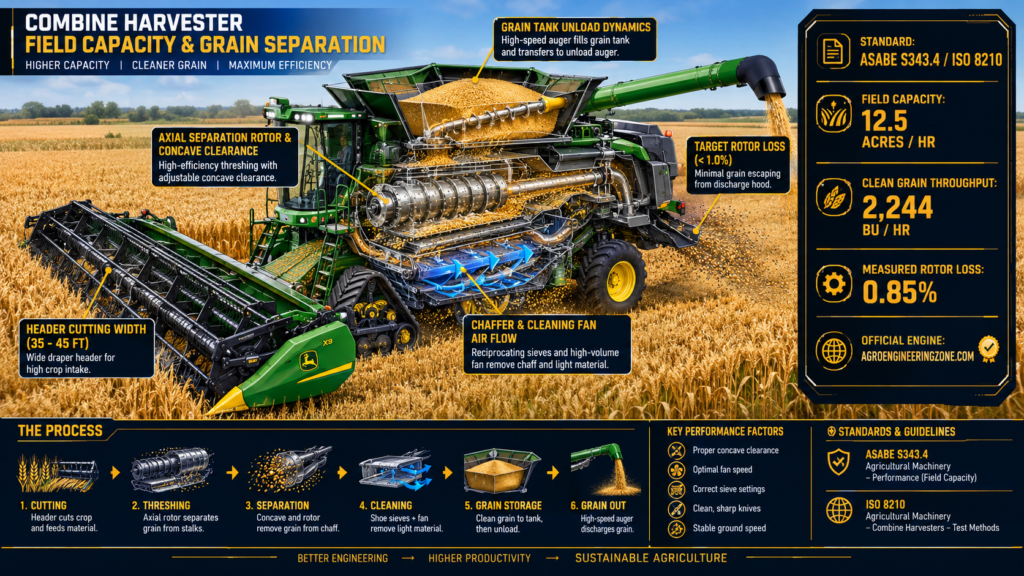
Combine Harvester Calculator: Capacity, Grain Loss & Best Ground Speed
Find hectares per hour, tonnes per hour and tank fill time, then see the cost-optimal ground speed where machine cost plus grain lost is lowest. Calibrate with your own loss counts. 15 crops, metric or US, any currency.
1. Machine & Crop
2. Your Loss Count (use our Harvest Grain Loss Calculator)
3. Costs & Settings (editable)
Speed vs Loss vs Cost
| Speed | Capacity | Loss | Total cost per area | Days to finish |
|---|
Combine Capacity & Speed Optimization Guide
A combine earns money by covering ground efficiently, but every extra km/h pushes more crop biomass through the threshing rotor and cleaning sieves, which rapidly increases separator and shoe grain loss. The most economical operating speed is rarely the maximum throttle speed—it is the balance point where hourly machine operating cost per hectare plus the market value of lost grain per hectare reaches its minimum.
Formulas Used
Capacity (ha/h) = width (m) × speed (km/h) × efficiency / 10
Capacity (ac/h) = width (ft) × speed (mph) × efficiency / 8.25
Throughput (t/h) = capacity × yield
Loss % at speed v = L0 × (v / v0)k
k = ln(L2/L0) / ln(v2/v0) when you enter a second measurement
Cost per ha = (machine + fuel per hour) / capacity + yield × loss % × price
The capacity formula is the standard ASABE machinery-management field-capacity equation. The loss-versus-speed curve is a planning model: real threshing and cleaning loss depends heavily on crop moisture, straw toughness, MOG (material other than grain) throughput, and rotor/concave clearance. For highest accuracy in your field, measure grain loss behind the combine at two different ground speeds, enter both pairs into the tool, and let it automatically calibrate the exponent k for your exact machine and crop conditions. Fuel use, hourly machine costs, and field efficiency are editable benchmark defaults, while weather timeliness risk is reflected in the total harvest days column.
How to Calibrate Loss & Manage Feed Rate
Two-Speed Field Calibration: Run your combine at your normal baseline speed (v0) and measure total header and separator loss (L0) using drop pans or ground counts. Then increase ground speed by 1.5 to 2.5 km/h (1 to 1.5 mph) on a comparable strip and record the second loss percentage (L2). Entering both values solves for your combine’s real-world sensitivity exponent (k), which typically ranges from 1.5 in dry, easy-threshing cereals to over 3.0 in tough, high-moisture straw or pod crops.
Balancing Feed Rate & Grain Cart Logistics: In high-yielding crops like irrigated corn or paddy rice, throughput (tonnes/hour) often limits ground speed before header capacity does. Tracking the tank fill cycle time helps you synchronize grain cart or tractor-trolley unloading cycles so the combine never sits idle waiting at the headland.
FAQ
Q – Why is my optimal speed lower than expected?
A – Either your loss rises steeply with speed (large k), your grain has a high market value per tonne, or your hourly machine operating cost is relatively low. Check each input to match your local rates.
Q – Is cotton included?
A – No. Cotton uses spindle pickers or brush strippers rather than grain combine harvesters.
Q – Does the tank fill time include unloading?
A – No, it shows how fast the grain tank fills at your current feed rate, which helps you schedule unloading on-the-go and size grain-cart logistics.
© AgroEngineeringZone.com — Results are planning estimates only, based on general assumptions and your own inputs. They are not a substitute for professional advice or manufacturer guidance. AgroEngineeringZone.com is not liable for decisions made using this tool.