
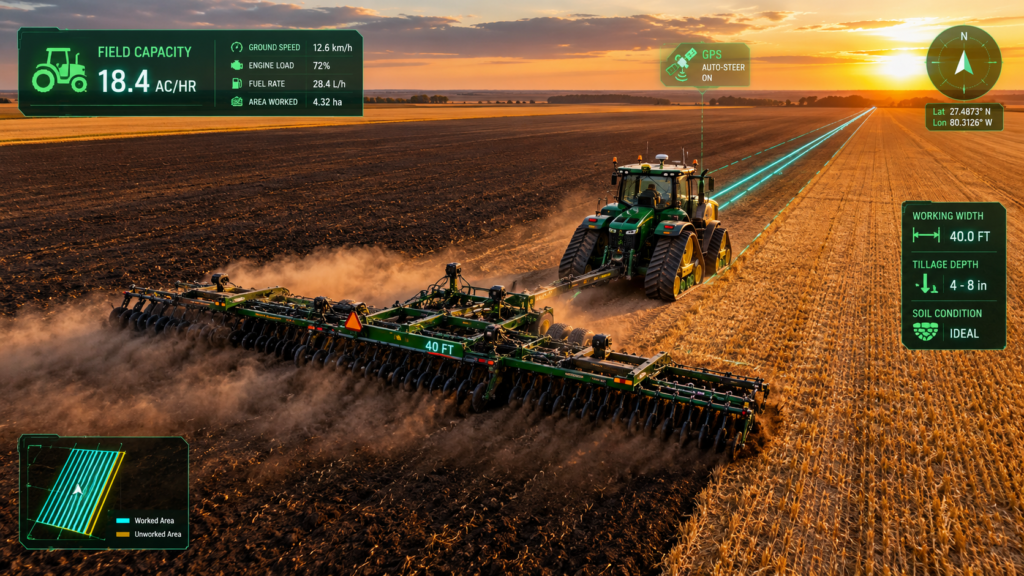
Acres Per Hour Calculator: Mowing, Plowing, Spraying & Harvest Time
Enter your machine width and speed in any unit, add your plot area, and get acres per hour, time to finish, cost per acre and the time GPS auto-steer would save. Works for lawn mowers, tractors, sprayers and combines. Free, worldwide.
1. Machine
2. Plot Area
3. Optional: Turns, Cost & GPS Saving
Calculator starting… if this line stays, JavaScript did not run on this page.
Speed vs Time Table
| Speed | Acres / hour | Hectares / hour | Time for plot |
|---|
How the Acres Per Hour Calculation Works
This tool estimates how much area a machine can work per hour and how long a plot will take. It suits lawn mowing, plowing, seeding, spraying and harvesting.
Formulas
Area per second = width × speed × (1 − overlap) × efficiency
Time = plot area / area per second
US shortcut: acres/hour = width (ft) × speed (mph) / 8.25
Metric shortcut: hectares/hour = width (m) × speed (km/h) / 10
Rectangular plot: passes = plot width / (machine width × (1 − overlap)), time = passes × run length / speed + (passes − 1) × turn time
Accuracy: every unit is converted exactly to SI first (for example 1 acre = 4046.8564224 m² and 1 mph = 0.44704 m/s), so the arithmetic is exact. Quick check: a 10 ft machine at 5 mph with no overlap gives 50 / 8.25 = 6.06 acres per hour. How close this is to your real job depends on your inputs: the straight-line formula suits large rectangular plots, and the turning model improves small or short-run plots. Obstacles, uneven ground, refills and unloading are not modelled unless you lower the field efficiency. Field efficiency already includes some overlap, so do not double count the same losses.
Units: are (a) = 100 m², decare (da) = 1000 m², cent = 1/100 acre, guntha (gunta) = 1089 ft². Regional units such as bigha vary by state or country, so they are not included.
FAQ
What overlap should I use? Manual steering often leaves 5 to 15 percent overlap. Use 0 if the job needs none, and a low value such as 1 to 2 percent if you have GPS auto-steer.
What efficiency should I enter? Leave 100 for a pure formula result. For real jobs with stops, refills and turns, use the turning model or enter your own measured efficiency, but then keep overlap realistic.
Can I use it for a lawn? Yes. Choose centimetres or feet/inches for the mower deck, and square feet or square metres for the lawn.
© AgroEngineeringZone.com — Results are planning estimates based on the formulas above and your own inputs. Real job time varies with field shape, obstacles, turns and conditions. AgroEngineeringZone.com is not liable for decisions made using this tool.