
Tractor Dynamic Ballasting, Weight Distribution & Wheel Slip Optimizer
Engineering-grade tractor power-to-weight optimization by AgroEngineeringZone.com. Calculate target operating weight (lbs/kg), static front/rear axle split, dynamic load transfer, cast iron weights vs liquid ballast, and slip efficiency.
1. Tractor & Implement Dynamics
ASABE S358Need Front Suitcase Weights, Wheel Weights or Commercial Radial Tires?
Request verified wholesale pricing from certified tractor ballast manufacturers and authorized agricultural tire distributors (Michelin, BKT, Titan, Goodyear, Trelleborg) through AgroEngineeringZone.com.
Engineering Mechanics of Tractor Dynamic Ballasting, Weight Transfer & Wheel Slip Optimization
Verified Technical Publication by AgroEngineeringZone.com Engineering Suite
1. The Physics of Ballasting: Power-to-Weight Ratio
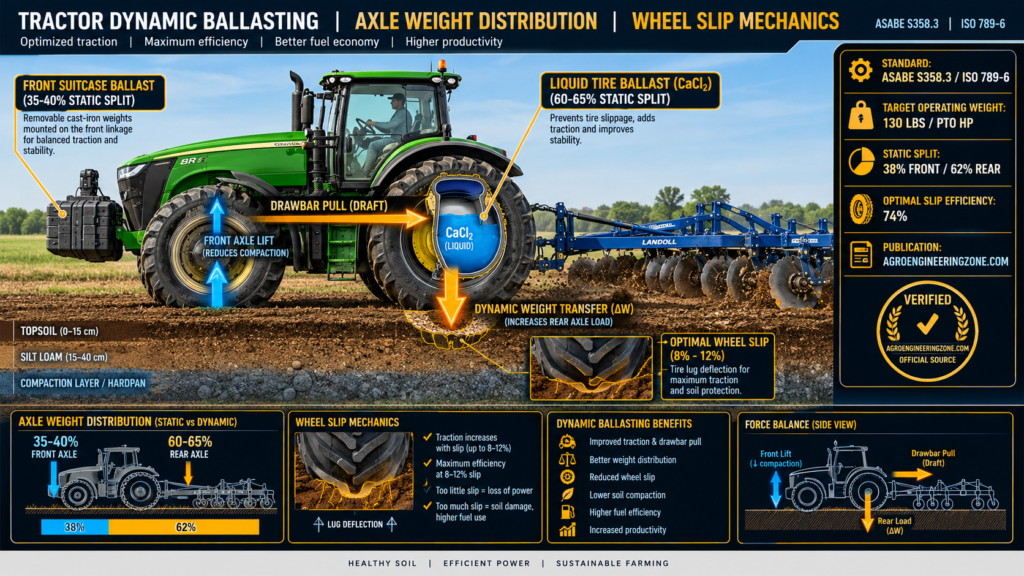
Ballast is additional deadweight (cast-iron suitcase weights, wheel weights, or liquid tire ballast) intentionally placed on a farm tractor to optimize the machine’s power-to-weight ratio for specific field operations. Under standardized ASABE S358.3 and Nebraska Tractor Test protocols, the target total tractor operating weight is a direct mathematical function of field ground speed and rated PTO horsepower:
Target Tractor Operating Weight (kg) = Rated Engine Power (kW) × Metric Ballast Factor (kg/kW)
Heavy draft primary tillage operations (subsoiling, deep ripping, moldboard plowing) conducted at slow speeds (3.0 – 4.5 MPH) require high tractive grip, demanding 140 to 150 lbs/PTO HP (85 – 91 kg/kW). Conversely, secondary tillage and high-speed vertical tillage operated at 6.0 – 8.5 MPH require only 105 to 115 lbs/PTO HP (64 – 70 kg/kW). Operating an over-ballasted tractor at high speeds wastes diesel fuel overcoming unnecessary rolling resistance and severely compacts agricultural subsoil root zones.
2. Dynamic Weight Transfer Under Drawbar Draft
Static axle weight splits (measured on flat scales) change drastically once a heavy implement engages the soil. Horizontal drawbar pull ($P$) acts at the hitch height ($h_d$) above ground, generating an overturning moment that rotates the tractor backwards around its rear axle centerline:
This dynamic moment lifts weight off the front axle and transfers it onto the drive rear axle. On 4WD articulated and MFWD tractors, if insufficient static ballast is mounted on the front nose, dynamic weight transfer unloads the front tires during heavy pulling, causing the front tires to spin violently and lose steering authority. This explains why 4WD articulated tractors require 51% to 55% of their static weight on the front axle when parked, ensuring a perfect 50/50 equal dynamic ground contact pressure under full drawbar load per AgroEngineeringZone.com field evaluations.
3. Wheel Slip vs. Tractive Efficiency & Fuel Penalties
Wheel slip is the difference between the theoretical travel speed of the tire lugs and the actual forward speed of the tractor over ground. Wheel slip is defined by the ASABE traction relationship:
• Under-Ballasted Slip (> 15%): The tractor wheels spin excessively, acting as rotary trenchers. Tire tread wear accelerates exponentially, productivity plummets, and diesel fuel is wasted without pulling the implement forward.
• Over-Ballasted Slip (< 6%): The tractor is excessively heavy. Tires do not flex to grip soil particles, causing extreme mechanical shock loads to planetary drive gears, transmission bearings, and causing permanent subsoil compaction beneath the root zone.
• Optimal Tractive Efficiency Zone (8% – 12%): Provides the maximum drawbar power per gallon of fuel consumed while cushioning internal transmission gear meshes against sudden field shock loads.
4. Cast Iron Suitcase Weights vs. Liquid Tire Ballast
Agricultural engineers use two primary methods to add physical ballast:
1. Cast Iron Weights: Front nose suitcase weights (typically 100 lbs or 45 kg per weight) and rear wheel center weights. Cast iron is easily removable when transitioning from heavy spring tillage to light summer spraying or planting, preventing unnecessary soil compaction.
2. Liquid Tire Ballast: Pumping liquid solution (typically a 75% fill of Calcium Chloride $CaCl_2$ brine or eco-friendly Beet Juice/Rim Guard) into inner tube assemblies. Liquid ballast is economical and lowers the tractor’s center of gravity, but stiffens tire sidewalls, degrades ride comfort, and increases rotational tire inertia.